
MICHIGAN FLIPPERS PINBALL LEAGUE
SEASON 5 (Summer 2026)
Congratulations to our Season 5 winner, Chris Tabaka, and runners up Daniel Tabaka, Cindy Yao and Ryan Jurado!
MFPL Season 6
MFPL is the only pinball league of its kind in Southeast Michigan. To join, just visit Pinball Pete’s and sign up at 5:00PM on a match day. We will do a call for signups before each session!
- Friendly
- IFPA Sanctioned
- Flexible – Drop 2 free sessions
- Fun for any skill level
- All Ages
- Players welcome to join at any point in the season
- Free parking in Maynard Parking Structure
If you’re looking for the results from a past season, check the MFPL archive.
League Calendar
Add Dates to Your Google Calendar (open in new tab)
Chosen Sundays
Playoffs on Dec 6
All sessions start at 5:00PM
Sessions typically end before 8:00 PM.
Sept 13
Session 1
The inaugural pinball league play day! Register in advance on Matchplay or with Ryan in the arcade basement.
Sept 27
Session 2
Because the lowest two sessions are dropped for each player, new folks can still join without any penalties.
Oct 11
Session 3
This is the final day players can join without taking any points penalties toward their playoffs seed.
Oct 25
Session 4
This is the final session new players can join and still be eligible for the playoffs (and IFPA points).
Nov 8
Session 5
From here forward, new competitors are considered social-only players and are ineligible for the playoffs.
Matchplay
Nov 22
Session 6
If you already attended 4+ sessions, then this session will just replace your lowest result to date.
Dec 6
Playoffs
All qualified players are invited to the playoffs to determine the final season outcome. Good luck! Any remaining tiebreakers will be played starting at 4:30 PM.
Season Standings
Current standings are available on Matchplay.
League Format
How to Join
Just walk down into Pinball Pete’s Ann Arbor. You’ll see a group of pinball players warming up in the basement; ask any of them where you can join the league and they’ll point you to Ryan or Cindy. It’s intimidating to walk up to strangers, but we promise that everybody is friendly!
Players only need to cover coin drop for their games and may be asked for $1 for the IFPA registration fee. There are no other fees or side-pots for this league.
MFPL Overview
During the season, players will be invited to play 6 total qualifying sessions. The sum of all the points earned in a player’s top 4 sessions will determine seeding into the playoffs.
The top half of players who participated will be eligible for the A division playoffs1. Only players who attended at least three sessions will be eligible for the playoffs2.
Session Format
Every session, players will play 6 randomly selected games, and each game will be played by 3-4 total players. Players will be paired up to face each possible opponent roughly the same number of times across the entire season.
For each game played, players will be awarded points based on their placement in that round.
Four-Player Game Scoring
| Rank | Points |
|---|---|
| 1st | 7 |
| 2nd | 5 |
| 3rd | 3 |
| 4th | 1 |
Three-Player Game Scoring
| Rank | Points Earned |
|---|---|
| 1st | 7 |
| 2nd | 4 |
| 3rd | 1 |
At the end of the night, a session-winner is determined by the sum total of points. There will be no tie-breakers for session results. Any outright session winners will earn a momento: a custom dog tag with their pinball initials given at the end of the season.3
Playoffs Format
Our playoffs format will vary depending on total participation. If 32 unique players join across all sessions, we will use our preferred playoff format.
With fewer than 32 unique players, we will revert to the ladder format used in Season 2.
Preferred format (assuming 32+ total players)
The top 16 players will be invited to play in the A-division finals. All other players will be invited to play in a B-division finals.
Each player will be seeded based on the sum of points earned in their top four sessions (dropping their lowest two). Any sessions not attended are scored as 0 points.
Seeding Tiebreakers
Players in a tie for any of the top 16 seeds will first play a tiebreaker on a random working machine.
Tiebreakers will be played at the end of the final session of the season if:
- All included players were in attendance at that session
- That session ends before 9:30 PM
Otherwise, any remaining tiebreakers will be played at 4:30PM the day of the playoffs, with affected players expected to arrive early enough to play.
Play order will be random and play will be simultaneous. If there are 5 or more players in the tie, then play will be broken into approximately even groups with the largest group playing last (e.g. a group of 2 then a group of 3).
Players who are not available to break ties during their scheduled playtime will automatically be given the lowest placement in the tie. Players may opt to forfeit a tie and take the lowest available position in that tie instead of playing the tiebreaker match.
Note that this tiebreaker will determine final seeding, which will also be used to break any final placement ties (see “final placement tiebreaker”).
A Division rules:
- Group A: Players ranked 1, 8, 9 & 16
- Group B: Players ranked 3, 6, 11 & 14
- Group C: Players ranked 2, 7, 10, & 15
- Group D: Players ranked 4, 5, 12 & 13
Game choice
Groups will have a leader who will choose one game that cannot be vetoed. Then the leader will pick 3 additional games that can be vetoed.
The highest-seed player who is not group leader will then veto one of those games.
This means the group leader will pick 4 total games. The group will only play 3 of these games.
Play order
The top seed of each group can either choose to “lead the group” or they may choose their play position and have veto power during the group.
If they choose position, the next seed may either choose a remaining play position or take group leader.
This continues until all play positions are chosen. Whoever takes “leader” will always be given the leftover play position.
Players may choose to change their play position from game-to-game, but they must do so with the same choice priority — the top-seeded non-leader will have first choice, down through seed order and the leader will always play the remaining position.
Scoring will be 7-5-3-1.
The two players with the highest sum of points across all three games will move forward. The other two players will be eliminated.
Round Tiebreakers
If there is a tie to advance between rounds, this will be broken by a tiebreaker on whatever game was vetoed in this group.
Additional Rounds
New groups will be formed from the top 2 players of each group in the prior round.
- Group E (round 2): Top players from Groups A and B
- Group F (round 2): Top players from Groups C and D
- Group G (round 3): Top players from Groups E and F
These groups will play the same as the first round. If a player leads multiple groups, they MAY NOT pick a game they have previously chosen as their definite (un-vetoable) game in any future rounds, even as a vetoable game. All other games may be picked again in future rounds.
Final Placement
After elimination, final placement will be determined by the round of elimination. All players who go out in the same round will have ties broken by their regular season rank.
This means the lowest final placement possible for the top-ranked regular season player is 9th place. For the second-highest regular season player will be 10th place, and so on.
Final Placement Tiebreakers
There will be no additional ties in final placement because all seeding ties will be broken in advance of the playoffs.
All players who are eliminated simultaneously will have their final placement ordered based on their seeding from the regular season.
For example, season seeds 11 and 3 are eliminated from Group E and season seeds 7 and 13 are eliminated from Group F. The final ranking for the season would be:
- 5th place: Seed 3
- 6th place: Seed 7
- 7th place: Seed 11
- 8th place: Seed 13
The number of points earned during the finals groups would not factor into these placements, as these players may have faced different opponents in their final groups.
We’ve made this decision to ensure players with stronger regular season performance retain an advantage from their regular season play regardless of whether they are getting to choose games.
A Division Non-Attendance
If a player who earned a space in A division fails to attend the playoffs, we will shift all lower A Division players up to fill empty space. Then any remaining empty spaces will be filled by the top-seeded B Division players in attendance.
The forfeiting A Division player(s) will have their final placement set starting at rank 17 (above B division playoffs).
Time expectation:
The finals should require 3 rounds of 3-4 games each. We believe this means most players will have their final placement within 2-3 hours, and the total event should be concluded within 4 hours.
If the final group has not started before 10:00 PM (after 4.5 hours of play), we reserve the right to reschedule the final 4 players to finish on a future Sunday when the tournament organizers are available at the usual 5PM slot. Affected players (and at least one TO) may otherwise unanimously agree to another date/time.
Shortening Group Play
If a group ends game two with a score of 12-12-4-4, the final game of that group may not be played to save time. This is because it is no longer possible for the lower-performing two players cannot possibly move on no matter the results of game 3.
If a group ends game 2 with a score of 14-6-6-6, the final game may only include the tied players because their final ranking could not be impacted by the player with 14.
In any other cases, all players will play through all three games because all players’ outcomes could impact the final standings.
B Division Finals
B Division may play a single-elimination ladder with all present players on finals day.
Each round, the four lowest-seed players will face off on a random machine that is not being used by an A Division match.
The highest seed player in the group may use one veto or pick play position for the match. If they choose to veto, then a new random game will be chosen.
From there, each player will choose play position in seed order.
The lowest scoring two players will be eliminated and their final placement in B division will be based on their order of elimination.
All players who do not attend B Division Finals will be placed below players who do attend, then ties will be broken by season seeding.
If there is a tie from regular season seeding between two B Division players not in attendance, then the position will be shared between all tied players.
Prizes & Accolades
There is are custom pinball-initial dog tag for any player who wins an individual session (regardless of their final placement). There may be trophies if we have time and resources to make them.
These prizes are provided at personal expense by the tournament organizers and are expected but not guaranteed.
All participating players who attend at least 3 sessions will gain International Flipper Pinball Association (IFPA) ranking, with more points for better-performing players.
Prizes & Accolades
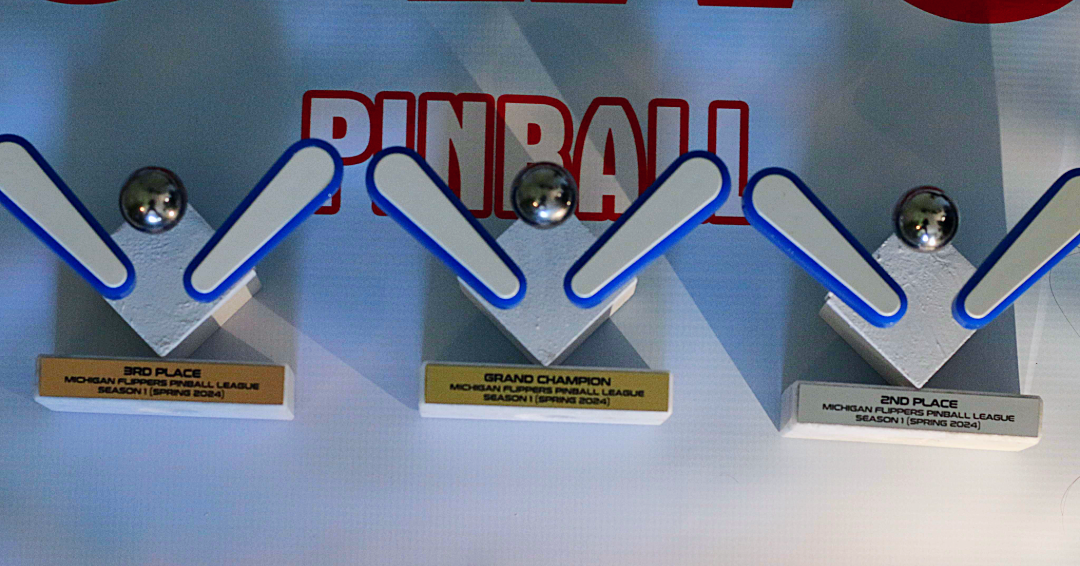
There is a custom trophy for the top 4 players, as well as a custom pinball-initial dog tag for any player who wins an individual session (regardless of their final placement).
All participating players who attend at least 3 sessions will gain International Flipper Pinball Association (IFPA) ranking, with more points for better-performing players.
League Rules
Except where discussed here, we’ll follow the rules & guidelines provided by the IFPA. This is a friendly league; we will try to enforce rules fairly and may ask players if they can reach a consensus regarding any issues prior to having an official ruling.
PLAYER CONDUCT
This tournament is run at an operating family arcade. In addition to the normal IFPA conduct, players will receive penalties for any behavior which could disrupt normal arcade patronage/operations.
KEEPING MACHINES PLAYABLE
Note: these rules have been edited for clarity. This does not come up often and we do not expect to need these rules; they are only here to prevent disagreement in an extreme scenario which impacts multiple players
We do not always have access to open a machine during play. This means we do not necessarily have the ability to safely move machines back into position after a big nudge. To avoid this, any player who moves a game into an unplayable position is responsible for fixing it during their own ball or bonus.
If a player moves a machine into an unplayable position (for example, into a wall) and fails to fix it before the next player’s ball, a tournament organizer will make a ruling. Reasonable efforts will be made to allow the machine to be played, this might include shifting nearby machines.
If a game is still unplayable after a reasonable effort, a tournament organizer will attempt to move the shifted game back into a playable position. If this cannot be done without causing a tilt warning, the active player can choose:
- Play the game in its condition
- Tilt out the ball and play a compensation ball from second game
At the TO’s discretion, failures to maintain equal playability of games can result in a warning. Multiple instances or egregious failures to maintain playability may result in a penalty. An “egregious failure” is leaving a machine unplayable intentionally, or failure to move a machine back when it would be risk-free to do so (for example, on Whoa Nelly where there is no post-ball bonus, players should always ensure the game is in a reasonable position prior to the end of their own ball).
- First offense: -2 points for session of the incident
- Second offense: -4 points for the session of second incident
- Third offense: -6 points for the session of the incident
- Fourth offense: A pattern of unsportsmanlike behavior will result in ejection from the season.
- Any offense: if leaving a game in an unplayable position created an unfair advantage/disadvantage that could not be avoided, a TO may disqualify the offending player from the round instead of a session point penalty.
CASUAL GAMES
Tournament players are welcome to play between sessions, but they must not play games adjacent to any ongoing tournament match. In addition, players should not delay tournament progress because of a non-tournament game.
BACK-TO-BACK MACHINES IN SESSION PLAY
Because machines will be randomly selected by Matchplay software, it is possible to be assigned the same game multiple rounds in a row. If any player in a group has just played a machine, any player in that group may request a randomly re-selected machine, but must make this request before play has started.
OCCUPIED MACHINES
It is possible a machine will be occupied by regular arcade patrons. If this is the case, the affected group will be randomly assigned a new game, excluding any tables which were played by any player in the affected group in the previous round.
In the playoffs, a game may not be selected in the pool if it is occupied by a regular patron at the time of selection. We will not be delaying the finals waiting for machines to become unoccupied. However, if a league player is playing a non-tournament game on a machine, they will vacate if needed.
MALFUNCTIONING MACHINES
We will not have staff available for hotfixing machines. We will do our best to ensure only games in reasonable working order are in the tournament pool.
If there is a significant malfunction which impacts a game more than twice during a single round, a new machine will be drawn and players will start over. Otherwise, we will be using IFPA guidelines to give compensation balls in the case of major malfunctions.
PLAY ORDER
We do not have any games in our pool which have play-order advantage such as ball lock steals.
If a player accidentally plays an opponent’s regular ball, that player will receive 0 points for the round. The player who lost their ball, can choose to either step in and play the ball from its current state (if possible) OR choose to play one compensation ball after the game is concluded.
A player who accidentally plays out of turn order for the first ball will be given a warning, but will be allowed to swap play order with the player whose ball they took. Repeated or seemingly intentional offenses may result in point penalties at the discretion of the tournament organizers.
If a game is added mid-season which has a significant play-order advantage, no warning will be given for play-order mistakes on that machine, even for a first offense.
TOURNAMENT MODE
Any player who knows how to use “tournament mode” through flipper shortcuts may request this feature be used for any of their assigned games. If even one player makes such a request, the game will be changed to tournament mode. All players on the machine must be given confirmation if this occurs.
The tournament organizer will not be enforcing “tournament mode” to prevent time waste. This should be managed by players.
EXTRA BALLS
We are unable to turn off extra balls. To save time, players must plunge out extra balls without playing them. A player may use any combination of the flipper buttons to set up the ball, but may not hold a flipper while plunging nor touch the game at all once the ball has left the shooter lane.
If a player steps away from the machine and allows their extra ball to be played by another player, they will AUTOMATICALLY be given second-to-last placement for that round. (i.e. second in a three-player game or third in a four-player game).
If a player plays another player’s extra ball, they will be given last place for that round.
In some cases, a game may repeatedly fail to validate the playfield during an extra ball. An opponent may announce they are stepping up to validate the playfield any time after 5 launch attempts (automatic or manual).
This means the opponent will step up to the machine and plunge into a switch to validate the playfield. If such a plunge isn’t possible due to the playfield, they may use the flipper to hit a switch, but must not activate a qualified mode or multiball at the disadvantage of the primary player.
To be honest, we only ever have this problem on The Beatles, where there’s no risk of abuse. In the case of uncertainty, players may attempt to cradle the ball on the flipper while seeking guidance from a tournament organizer.
RAGE QUITS, ABANDONS AND NO-SHOWS
Sometimes, casual players will join our league and opt out partway through a session.
If a player verbally affirms they no longer want to play, they will be given an automatic last place for the current round and removed from the remainder of the play session. Players will be permitted to return for future sessions, and all sessions joined will count toward attendance (even if a player opts to forfeit partway through).
If a player can’t be found after 3 minutes of waiting, the players in attendance may start without them. If in doubt, request a confirmation from a tournament organizer before starting a round without an opponent.
In the finals bracket, a player who leaves/quits will be given an automatic last place for the remaining games in their bracket matches until they are eliminated or until they return. Games will start without them and they will not be permitted to rejoin mid-game.
LATE ARRIVAL
We are a friendly-first league, but we will not be delaying the tournament for player arrival. If a player is late, their opponents may start round one without them.
Registered players arriving late in good faith may be given the chance to play a blind round one if they arrive ready-to-play while at least one other round 1 game still running (and on ball 2).
A blind round means the player will play a single one-player game without knowledge of their opponents’ scores.
This is a courtesy and not a right; it can be withheld at the discretion of tournament organizers.
GENERAL COURTESY
Please follow these common-sense expectations. If you are a parent playing with your children in the league, please make a reasonable effort to ensure your kids also follow these expectations:
- Stand out of line-of-sight: Do not stand where an active player can see you. This means stand behind players, not in front of them or directly to the side.
- Don’t rage slam machines: It’s okay to be frustrated. It’s not okay to push the game out of position or strike it aggressively.
- Don’t distract players: It’s okay to chat near an active player, but do not talk to an active player. You can respond to an active player if they speak to you first. You may warn a player if they are unknowingly breaking a rule, for example, if they are playing with a stuck ball during multiball.
- No active coaching: once a player has plunged their ball, no other person may help them by providing instructions, guidance or game rules. Coaching may resume once a player has turned away from the machine and is no longer touching it. This means you may warn players if they accidentally step away from a machine before their ball ended or if they failed to plunge an extra ball.
- Watch your opponents: You are responsible for watching an opponent to see if they break any rules during play. Many players may not know the games they are on, and therefore may not even be aware if the machine is working as expected.
- Be kind
- Help new players
CONFLICT OF INTEREST
Both our tournament organizers also play in this tournament. Whenever possible, tournament organizers will not rule on their own games. Whenever possible, tournament organizers will look for player consensus when making a ruling on a game with another tournament organizer as a player.
If a consensus cannot be reached, other players with tournament organization experience may be consulted for a quorum. We try to be as fair as possible. If you do not like a ruling because you think it is biased, please (politely) let an organizer know so we can review.
This is a long league, the results of any single individual game rarely have a seismic impact on the overall results. Please keep everything in perspective when dealing with rulings.
- Top half of players rounded down to the nearest whole number or 16 players, whichever is smaller. ↩︎
- IFPA rules dictate that players who fail to attend half of all season sessions are not eligible for the playoffs or IFPA ranking ↩︎
- Tied session winners can do a random game tiebreaker if they want to determine who wins a dog tag for that session. These tie breakers are for pride/glory only and will have no impact on league standings. If no tiebreaker is played, then the dogtag will be made for whichever player has won fewer dog tags over all seasons of MFPL. ↩︎